
|
SALT/PFIS Observer's Guide
|

|
2. Instrument Overview
2.1 Optical Design
PFIS resides at the prime focus of SALT. The Spherical Aberration Corrector
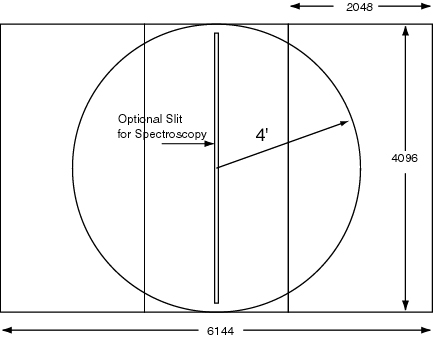
(SAC) delivers a F/4.2 beam providing a flat, 8 arcminute diameter field of view at the focal plane,
with a plate scale of 4.5 arcsec/mm.
2.1.1 Collimator and Camera
PFIS is an all-refractive collimator and camera system, optimized for
spectroscopic performance in the 320-900 nm wavelength range. The collimator
has 9 lenses in 5 groups plus a fold mirror before the last doublet. In the
150 mm diameter collimated beam are the shutter and the dispersers, which
include one of six gratings (five volume phase holographic (VPH) gratings and
a standard transmitting surface relief grating) or a double-etalon Fabry-Perot
system. The camera (F/2.2, 8.6 arcsec/mm) has 9 lenses in 4 groups, with the
final lens, a field flattener, being the dewar window. All optical surfaces
are spherical except for the first surface in the camera, which is an
asphere.
The collimator is designed to work in the 320-1700 nm range, to accomodate a
future near-infrared camera. Air-glass interfaces in the collimator will be
coated with either a MgF2/Solgel hybrid or just a MgF2
antireflection coating. Camera surfaces will be coated with a
MgF2/Solgel hybrid or multi-layer antireflection coating.
To compensate for image error introduced by possible differences in filter
thicknesses and uncompensated thermal effects, the camera will have an active
focus system. Focusing will be accomplished by moving the singlet and the
triplet in the camera together. Additionally, the camera will need to be
refocused for each configuration, as the imaging was not optimized for all
wavelengths simultaneously. However, a fixed focus position can be set for
each configuration. Then final focus error due to filters/thermal effects
can be removed.
2.1.2 Gratings
PFIS will have a complement of five volume phase holographic (VPH) gratings and
one standard surface-relief transmission grating. The gratings were chosen to
provide spectroscopic capability over the entire wavelength range of the
detector and resolving powers from R=500 to R=5500 (with typical slit widths).
The VPH gratings provide high
diffractive efficiency and significantly reduced scattered light as compared
to standard surface-relief gratings. Also, VPH gratings can be tuned to shift
the diffraction efficiency peak to a desired wavelength. The use of such
gratings requires the camera to be able to articulate, to accommodate various
grating tilts. The grating will reside on a rotatable stage, and the entire
camera will articulate about the same axis as the grating rotation, so that the
grating is always used in a Littrow configuration.
2.1.3 Fabry-Perot Etalons
PFIS will implement a double etalon system, allowing resolving powers from
R=500 to R=12500 over a full octave in wavelength (430 - 860 nm).
On a telescope the size of
SALT, this provides a high dispersion, high spatial resolution diffuse-object
capability with a net efficiency that exceeds slit spectroscopy by more than an
order of mantidue, since the detector pixels are more efficiently multi-plexed.
The system will have three spectral resolution modes: low (R=500 - 1000,
tunable), medium (R=2500), and high (R=12500). Low-resolution mode will use
a single etalon, with an interference filter to select the desired interference
order (corresponding to wavelength). The medium- and high-resolution modes
will use two etalons in series, with the low-resolution etalon and its filter
selecting the desired order of the medium- or high-resolution etalon,
respectively. Two of the three etalons will be installed at any time; the
low-resolution etalon will reside on PFIS at all times, while the one or the
other of the medium- and high-resolution etalons will be installed.
2.1.4 Polarimetric Optics
Polarimetric observations will utilize a ``wide-field'' design, in which a
polarizing beamsplitter in the collimated beam takes the central half of the
field and splits it into two orthogonally polarized fields, the ``ordinary''
(O) and ``extraordinary'' (E) beams. A polarization modulator preceding the
beamsplitter modulates the polarization state with time, and the difference
between the intensities of the O and E images as a function of time yields the
polarization.
The beamsplitter is an array of calcite Wollaston prisms, inserted in the
collimated beam just before the first camera element. This ensures that there
is no vignetting of the split beam, which would compromise the polarimetric
precision. Additionally, by placing the beamsplitter after the dispersers,
both the O and E beams have the same wavelength gradient in Fabry-Perot mode.
The modulator consists of two rotating superachromatic mosaic waveplates,
a 105 mm half- and a 60 mm quarter-waveplate. The modulator should be ahead of
any optical elements with polarization sensitivity, like the fold mirror and
the dispersers.
2.2 Detector CCD array
The detector subsystem comprises a cryostat containing a 3x1 mini-mosaic of
CCD chips. The chips are E2V (formerly Marconi) 44-82 CCDs
(Data Sheet) with 2k x 4k x 15 micron pixels.
The mosaic is housed in an evacuated cryostat and thermally connected to the
cold end of a Cryotiger, which cools the chips sufficiently to render dark
current insignificant while minimizing QE reduction. The detectors are
managed by an SDSU III CCD controller, which is in turn controlled by a PC.
2.3 System Efficiency
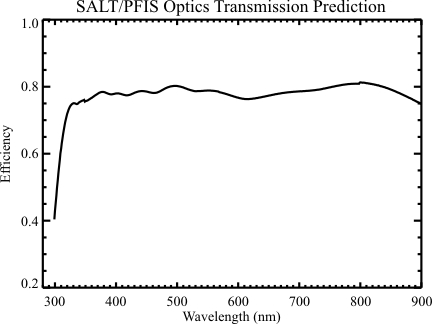
Below is the predicted throughput performance of the PFIS optical
system. This plot excludes the CCD QE and any of the dispersers or polarimetric
optics. We expect the throughput to be in the 75-82% range across the
entire visible camera wavelength range.
Up: Table of Contents
Previous: Introduction
Next: Observing Modes