
The Robert Stobie Spectrograph
The University of Wisconsin–Madison · Department of Astronomy · Space Science and Engineering Center

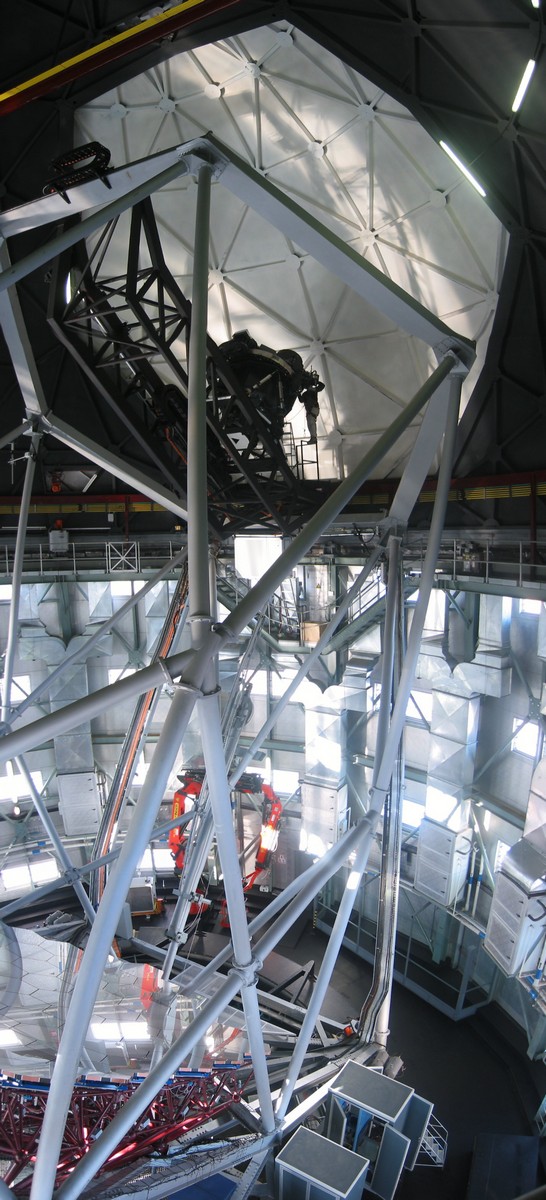
The Robert Stobie Spectrograph (RSS) is a dual-beam Visible/Near-IR spectrograph that uses Volume Phase Holographic (VPH) gratings to achieve high throughput from 320 nm to about 1.7 microns.
The two beams can be used simultaneously to achieve spectral coverage over the full spectral range of 320 nm to 1.7 microns. Each beam supports long-slit and multi-object spectroscopy, Fabry-Perot imaging spectroscopy, and spectropolarimetry. The visible beam supports high-speed spectroscopic modes as well.
With simultaneous spectral coverage from the UV (25% throughput at 320 nm) out to 1.7 microns in the IR, the RSS is unique among or superior to existing 8-10m telescopes in the UV, in medium resolution spectroscopy, in Fabry-Perot spectroscopy, and in spectropolarimetry.
The RSS is spread across at least 3 web sites:
- The SALT RSS observer's page, intended for the astronomical community
- The engineering web site (this one); the builders' site, with data sheets, product manuals, and all sorts of technical info
- The RSS/NIR management web site, with NIR PDR docs, meeting minutes, and controlled documents

The Robert Stobie Spectrograph, formerly known as the Prime Focus Imaging Spectrograph (PFIS), is named in honor of the late Director of the South African Astronomical Observatory. We will miss his enthusiasm and wisdom as SALT achieves its full potential.